 DamaSight
Prepare the first stack
The quality of the first joint begins before the material enters the furnace.
Make the arrangement explicit.
- Define the goal and orientation. Draw the A/B sequence, thicknesses, intended display face, and planned cutting or patterning route. A total layer count is not enough.
- Prepare the contact surfaces. Remove oil, rust, coatings, and uncontrolled scale; address warping and obtain flat, close contact. A maker’s success with a particular surface condition does not validate arbitrary contamination. [2] [3]
- Assemble and inspect. Check alignment, gaps, and bowing. Record why the outer materials and thicknesses were selected; workshop practices such as thicker outer sheets require their own verification.
- Secure and handle. Use a holding method suited to the equipment. Tack welds hold the arrangement; they do not replace the internal forge weld. Keep unwanted weld material outside the intended pattern.
- Preserve a baseline. Photograph the end face, mark orientation and sample numbers, and measure the original dimensions. Plan retained pieces for later checks.
A stack is a plan for future surfaces.
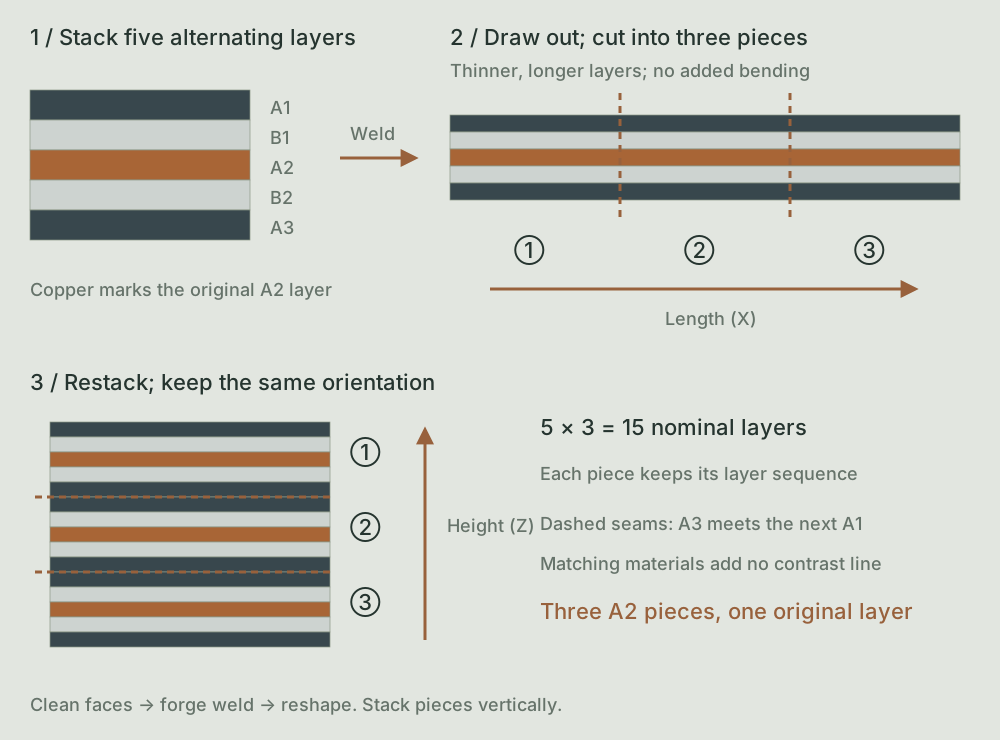
The broad sheet face and the end face reveal different things. Mark both before the first operation. As pieces are cut and moved, preserve their relationship to the original material instead of renaming a face every time the billet changes position.
Can extra flux compensate for a visible gap?
No. Joining still requires compatible materials, prepared contact, through-heating, and suitable pressure. Flux does not solve a geometric gap, contamination, and incompatibility at once.
The Pattern Notebook · 4 of 18Visual learning. Real-world results vary.