 DamaSight
Draw out, cut & restack
Track the original layer through the operation. Keep layer count and visible contrast separate.
Give every direction a name.
In this notebook, X follows the original bar length, Y its width, and Z its thickness. The broad sheet face P lies in X–Y; the original pattern end face E lies in Y–Z, perpendicular to X. E remains the tracked face when the workpiece turns. Always name the axis when describing a rotation.
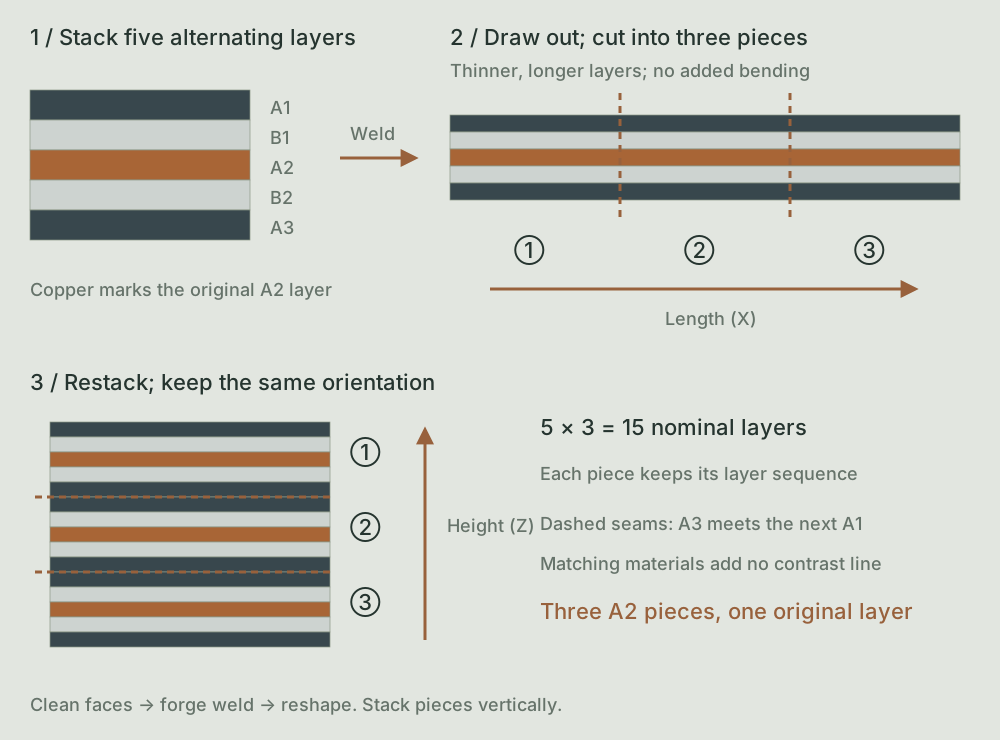
Five sheets become fifteen nominal layers.
- Stack A1–B1–A2–B2–A3. The example uses five sheets to make their identities easy to follow, not to recommend a production count.
- Establish the joints. The A/B arrangement remains. Welding does not melt the layers into a uniform liquid or create extra sheets.
- Draw out along X. Under ideal uniform deformation, the layers become longer and thinner while staying straight.
- Cut across X into three pieces. Each piece still contains the five-layer sequence. The three pieces of A2 all came from one original sheet.
- Stack along Z with X aligned. Prepare the new contact faces, join, and reshape. The end face now contains three repeated groups: fifteen nominal layers.
- Check the seams. A3 meets the next A1 at a group boundary. Matching materials do not necessarily create another A/B contrast line.
“Restack” can mean different arrangements.
| Arrangement | What changes |
|---|---|
| Stack along Z | The layer group repeats through the height. |
| Place side by side along Y | The end-face pattern gains width and lateral seams; thickness count does not automatically multiply. |
| Join end to end along X | The bar gains length; cross-sectional layer count need not increase. |
| Rotate about X, then assemble | Layer orientation changes. Rotation alone does not create a W or feather structure. |
What’s in the stack?
Cut into equal pieces and stack all pieces through the thickness. Keep the same arrangement each round.
A count of sheets, not visible contrast lines or a performance grade. Matching neighbors, loss, diffusion, and grinding are not modeled.
Drawing out reduces cross-sectional area while increasing length; upsetting shortens the billet while increasing its cross-sectional area. Record the direction of pressure, numbered units, contact faces, and any rotation or flip. “Restacked three times” cannot reconstruct that information. [54]
More layers generally mean thinner layers. Grinding, diffusion, and finishing may reduce contrast as layers become finer. There is no universal optimum count across materials and display faces. [15]
The Pattern Notebook · 6 of 18Visual learning. Real-world results vary.