 DamaSight
How a section becomes a pattern
Every point on a surface belongs to material somewhere inside the billet.
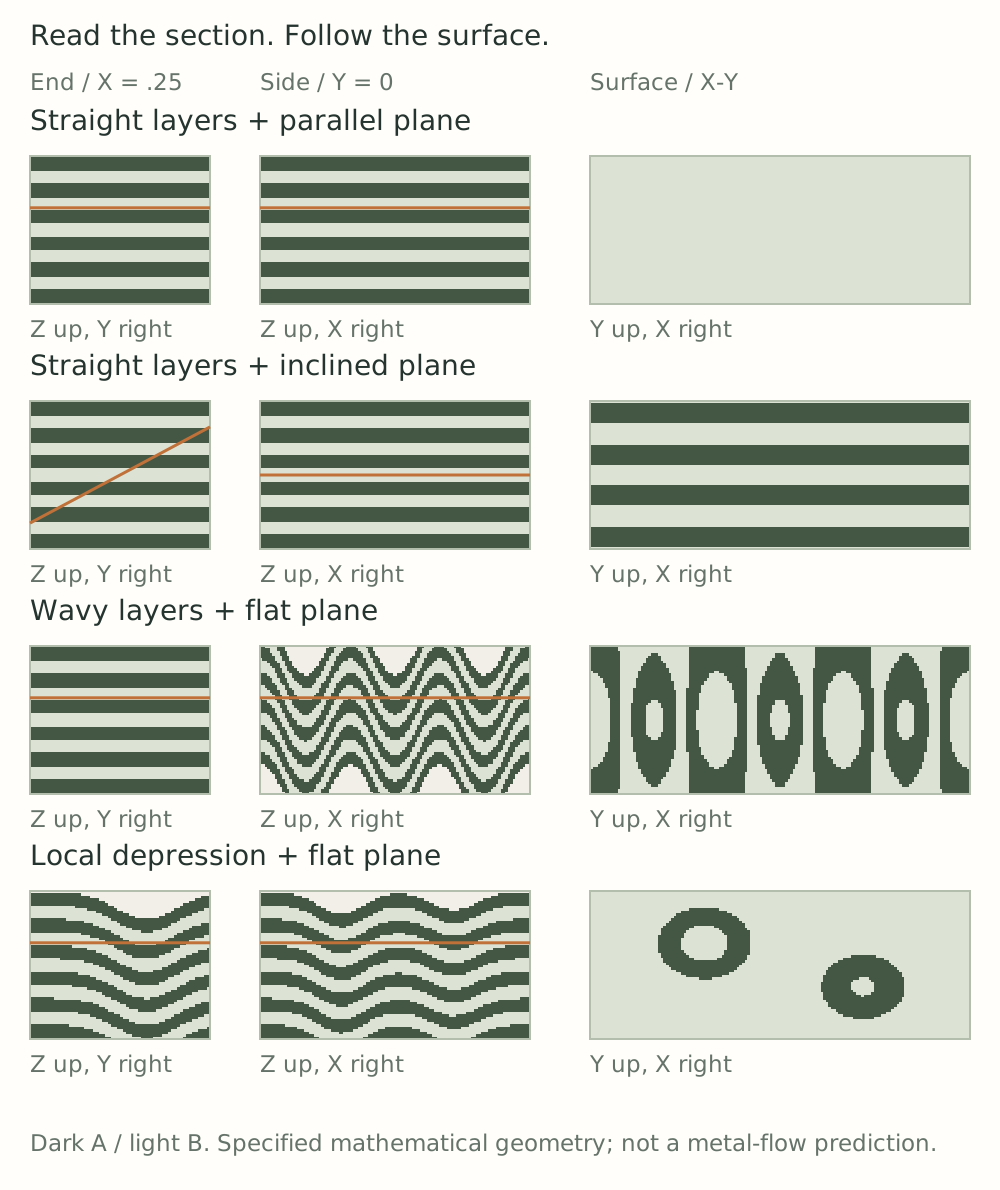
The visible pattern is the intersection of a three-dimensional material arrangement and the chosen surface.
Why the broad face can look plain.
Imagine perfectly straight layers with interfaces at constant Z. A broad surface parallel to them can remain entirely inside a single sheet. Seeing all the layers at the end does not mean they must all appear on that broad face.
An inclined surface crosses different Z values as it moves across Y. It can therefore expose A, B, A, B in succession, producing straight lines along X. If the layers first bend, twist, or move around a depression, a flat surface can instead intersect curves or closed rings. This is a geometric explanation; real forging adds uneven flow and thickness changes. [68]
Try a different view of the same material.
Change the process stage, move the section, and alter its angle. Keep the material fixed while you compare views. This is the same sample used on the homepage.
Simulated material arrangement for visual learning, not a calibrated prediction of physical forging.
Trace one surface point.
- Locate its X and Y position on the finished surface.
- Determine its Z height. A bevel changes height across its width; a whole object cannot always be described by one grinding-depth value.
- Ask which original material occupies that point. Adjacent regions belonging to different materials form a boundary.
- Use finishing to reveal the existing distribution. Etching changes contrast and relief; it does not create the internal geometry of a feather.
Two more choices shape the result.
Outline and surface geometry: cutting an outline from a patterned plate selects part of that plate. A bevel, shoulder, or curved surface changes which depth is exposed at each point. Later forming: drawing out, widening, and tip formation continue to move the layers, so an earlier end-face photograph is not a final-surface prediction.
Look at the geometric relationship.
For straight interfaces Z = cᵢ and an inclined surface Z = a + bY, intersections occur at Y = (cᵢ − a) / b when b ≠ 0, producing lines along X. An ideal twist can be queried by rotating a point back into the original section: Z₀ = Z cos θ(X) − Y sin θ(X). These are geometric relationships, not a metal-flow simulation.
The Pattern Notebook · 7 of 18Visual learning. Real-world results vary.